
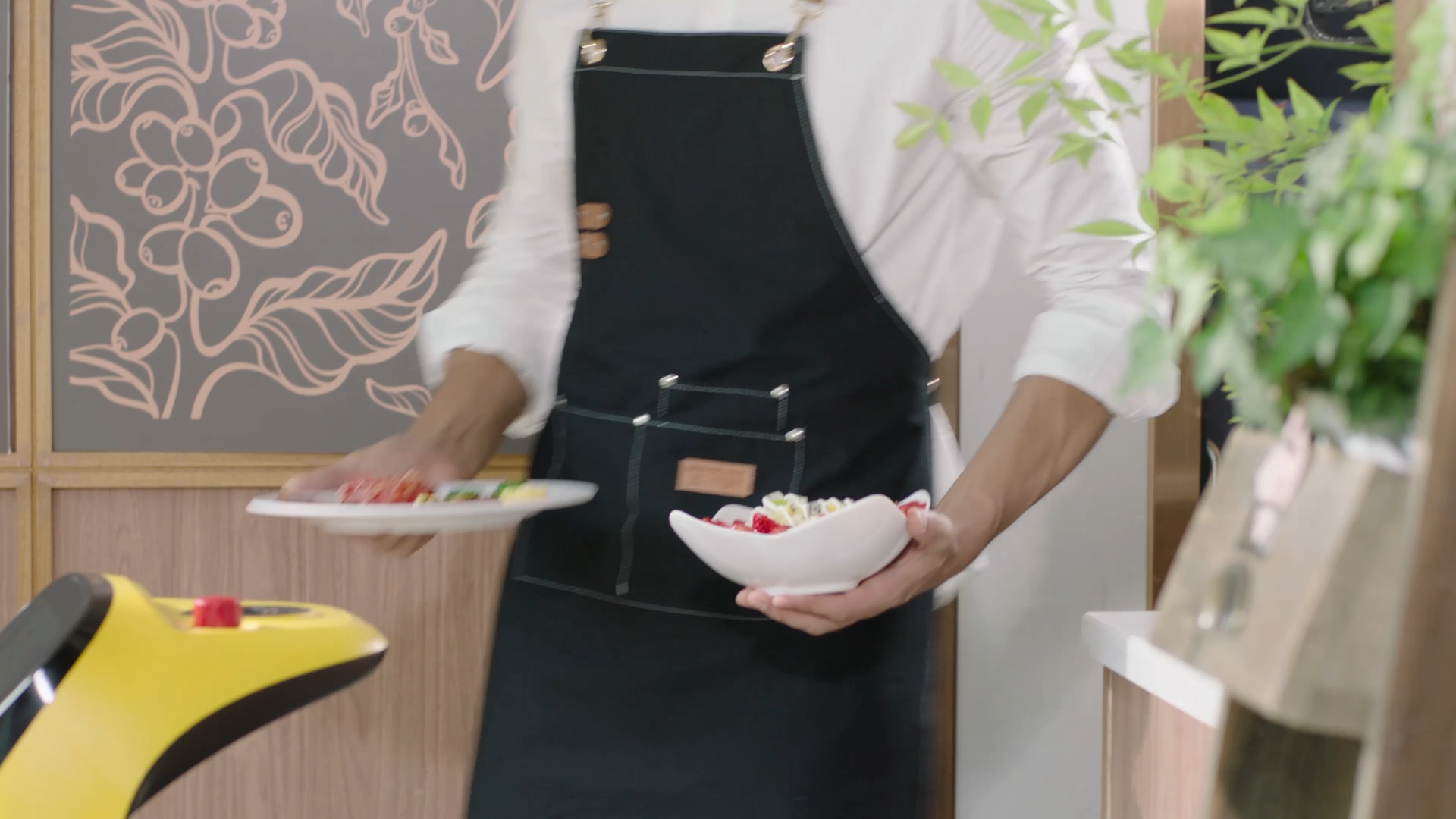
Walk into a busy restaurant today, and you might notice something that would have seemed like science fiction just a few years ago: robots carrying trays of food, guiding guests to tables, or even helping with dishwashing in the back of house (something you can't see, but can sometimes hear).
At first glance, they may seem pretty “static” or easy to understand: programmed once, then left to repeat the same motions
forever. No different from a hamster inside its plastic exercise wheel. But the often unseen truth is far more exciting: service
robots don't just stay the same. They get better through time. Often faster than most people, patrons, and even chefs restaurant
staff themselves realize.
Thanks to software updates, cloud connectivity, and AI-driven improvements, modern restaurant robots evolve long after they're
purchased. Unlike a fryer or an oven that degrades with time, a robot can actually gain new capabilities,
learn from its environment, and deliver more value every year it operates.
This shift changes the way operators think about automation. Buying a robot isn't just acquiring a piece of equipment; it's
investing in a platform that continuously adapts and improves. In this article, we'll explore how restaurant robots grow smarter
over time, what those updates look like, and why this “aging in reverse” makes automation one of the most future-proof investments
a restaurateur can make.
From Hardware to Platform: A Smartphone Analogy
The easiest way to understand how robots improve is to compare them to smartphones. When you buy a new phone, you're not just buying the
device as it exists on day one. Every few months, software updates roll out, bringing new features, security patches, and better performance.
Now imagine that smartphone can move, interact with, and actively perceive its surroundings.
Service robots work the same way. Most come equipped with connectivity (Wi-Fi, 4G, 5G, etc.), allowing manufacturers to send
over-the-air (OTA) updates. These updates don't just fix bugs, but fundamentally expand what the robot can do.
For example:
- A robot purchased in 2022 might have started as a basic food runner.
- By 2023, an update was rolled out that added multi-table delivery, allowing it to serve several groups at once.
- By 2024, AI-enabled navigation let it learn and optimize routes in real time, both avoiding collisions even in crowded dining rooms and getting to its destination faster.
The longer you keep the robot, the more capable it becomes. That's a very different ownership curve from almost every other piece of restaurant equipment.
Next-Level Navigation With Every Update
One of the most noticeable areas where robots improve over time is navigation. Early models relied on pre-programmed paths
and required operators to manually set waypoints. It worked, but it was clumsy. Clunky. Complicated. Staff had to be careful about layout changes,
and robots sometimes froze if something unexpected blocked their route. So it just stands there, no different from a stalled sedan in the middle
of a busy street. A nuisance nobody needs.
Today, AI and machine learning are transforming that experience. With each update, robots gain:
- Dynamic Obstacle Avoidance: Instead of halting when a chair is in the way, the robot can reroute instantly.
- Crowd Flow Learning: Robots start to recognize busy hours and adapt their pathing to avoid bottlenecks.
- Map Expansion: With software updates, robots can handle more complex layouts, even multi-floor environments with elevators.
This means a robot purchased three years ago may now navigate with the grace of a seasoned server weaving through a Saturday night dinner rush — all because its software has learned and improved.
From Food Running to Customer Engagement
Another way robots improve is through expanded functionality. A robot that started life as a tray carrier can, with updates, learn to handle new jobs:
- Bussing and Cleaning: Updates enable robots to return dirty dishes back to the kitchen.
- Greeting Guests: Integration with voice AI allows robots to welcome customers or provide directions.
- Upselling and Promotions: Some updated robots can display rotating digital menus or push special offers on their built-in screens.
- Kitchen-to-Front Sync: Robots can now be tied directly into POS systems, automatically picking up orders when they're ready.
This evolving and growing task list allows operators to extract more value from the same robot without buying new hardware. It's like hiring an employee who keeps learning new skills for free.
The Economics of “Getting Smarter”
From a financial standpoint, this matters a lot. Traditional restaurant equipment has a depreciation curve: the longer you own it, the less it's worth and the more maintenance it requires. Robots flip this on its head.
- Year 1: Robot handles 20 deliveries per shift.
- Year 2: After an update, it can do 35 deliveries thanks to multi-tasking.
- Year 3: Integrated with POS, it now runs autonomously with no staff prompting, freeing up an extra human server.
The ROI grows each year, not shrinks. According to a 2024 report by Hospitality Technology, restaurants using robots with regular
updates saw operational efficiency improve by 22% over three years, compared to just 7% in venues where the robots were left un-updated.
In other words: the software updates aren't just nice-to-haves. They compound the financial benefits over time. Here are just a few examples:
They're clear, but they could flow a little smoother. Right now, they sound more like raw notes than polished statements. Here's a tightened-up
version of each, keeping the meaning intact:
- Food runner robots introduced in the late 2020s have since been upgraded with bussing functions and smoother navigation. Today, hundreds of U.S. restaurants report that their three-year-old bots are actually more efficient than when they were brand new.
- Delivery bots have evolved with interactive voice features, transforming them from simple couriers into both servers and customer-engagement tools.
- Early bot models all needed manual mapping. Today, updates have enabled simultaneous multi-robot coordination, letting several units operate in the same dining room without collisions.
These cases illustrate the broader truth: service industry robots are becoming more valuable over time because their software roadmaps keep adding functionality.
Safety, Compliance, and Peace of Mind
Updates aren't just about making robots smarter; they're also about keeping them safe and compliant. Just as your
phone gets security patches, robots receive updates that address vulnerabilities or adapt to new regulations.
For example:
- If local fire codes change how equipment must operate in hallways, a software patch can ensure compliance.
- If a navigation algorithm has a rare bug, updates fix it before it becomes a liability.
- If new safety features (like emergency stop gestures) are introduced, updates roll them out system-wide.
This means restaurant owners don't have to worry about robots “aging out” of compliance. They evolve to stay aligned with standards.
The Role of AI and Data Sharing
Behind the scenes, the intelligence of service robots isn't just coming from one restaurant. It's pooled across thousands. Many robots
share anonymized data with manufacturers, creating a collective learning system.
That means if a robot in New York encounters a specific challenge (say, navigating narrow aisles with bar stools), the solution might
be rolled out as an update to every robot worldwide.
This network effect ensures that robots in cities like Los Angeles, Paris, London, New York, or Austin benefit from the experiences of robots
everywhere else. The longer the global fleet operates, the smarter each individual robot becomes.
Customers and Staff Perception: Novelty to Normalcy
When robots first rolled out, they were often seen as a novelty — something guests would take selfies with. That initial buzz from the
early 2020s was indeed valuable, but the long-term benefit comes when customers start viewing robots as normal parts of
the dining experience.
Updates accelerate this transition. As robots get smoother, friendlier, and more integrated into service, they stop being gimmicks and start being
expectations. Guests don't just think, “That's cool.” They think, “This place runs smoothly.”
Interestingly, it's not only the robots that improve over time. Staff do, too. As updates make robots more capable,
employees discover new ways to integrate them into workflows in the restaurant's day-to-day operations.
In year one, servers may only use the robot for heavy trays. By year three, they might rely on it for everything from dish returns to upselling.
This co-evolution between staff and robots creates a virtuous cycle of efficiency.
What “Smarter With Age” Really Means
Looking forward, we can expect updates to unlock even more advanced capabilities:
- Predictive Maintenance: Robots that self-diagnose issues before they cause downtime.
- Energy Efficiency: Smarter charging and battery optimization extending runtime.
- Contextual AI: Robots that recognize repeat customers and adapt greetings accordingly.
- Multi-Language Communication: Expanding support for diverse customer bases.
- Integration With Other Robots: Coordinated “robot fleets” managing entire front- and back-of-house workflows.
This means that a robot purchased today in 2025 could still be delivering greater value in 2030 than it did on day one — a claim you can't make for ovens, POS terminals, or even human training investments.
Final Thoughts and Updates
Restaurant robots aren't static machines. They're living platforms, constantly improving through updates, AI integration, and shared learning.
Unlike most assets that lose efficiency over time, robots grow smarter and more valuable the longer you use them.
For operators, this creates a powerful incentive: adopt early, and you won't just benefit today. You'll benefit from every future upgrade, every
collective learning breakthrough, and every new function rolled out across the industry.
In other words: buying a robot isn't just preparing for today's staffing challenges. It's investing in a smarter, continuously evolving
future for your restaurant. They're evolving partners that learn, adapt, and grow alongside your business.
If you're ready to future-proof your operations and explore how intelligent automation can transform your restaurant, visit USABots.com and book a call today.